Top of page
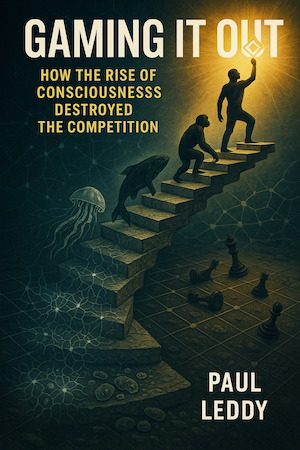
Book cover: Gaming It Out

Gaming It Out

Intro and Chapter 1 • Stream or download • Accessible native audio players

Sample Text

The graveyard of evolution is littered with the remains of the less conscious. From the Ediacaran fauna's primitive touch responses to the complex but limited sensory worlds of trilobites, from the simple affective drives of early vertebrates to the sophisticated but non-symbolic cognition of extinct hominins, the fossil record tells a consistent story: at every major transition in the history of life, organisms with greater conscious capacity systematically replaced those with less. This is not a tale of random extinction or environmental catastrophe. It is a story of competitive displacement—a biological game where each new level of consciousness provided advantages that previous levels could not match.

Listen
Introduction Download MP3
Read Introduction

Introduction: The Evolutionary Framework of Consciousness

The graveyard of evolution is littered with the remains of the less conscious. From the Ediacaran fauna's primitive touch responses to the complex but limited sensory worlds of trilobites, from the simple affective drives of early vertebrates to the sophisticated but non-symbolic cognition of extinct hominins, the fossil record tells a consistent story: at every major transition in the history of life, organisms with greater conscious capacity systematically replaced those with less. This is not a tale of random extinction or environmental catastrophe. It is a story of competitive displacement—a biological game where each new level of consciousness provided advantages that previous levels could not match.

Consider the Cambrian explosion, that remarkable period 540 million years ago when complex life forms suddenly proliferated across Earth's oceans. Traditional explanations invoke environmental changes or genetic innovations, but a deeper pattern emerges when we examine which lineages survived and which perished. The winners possessed something revolutionary: integrated sensory systems coupled with neural networks capable of coordinating responses. The losers—those limited to primitive touch and chemical gradients like the Ediacarans—could not compete with organisms that could see, model their environment, and respond strategically. They were not merely outcompeted; they were hunted to extinction by predators operating at a higher level of conscious awareness.

This pattern repeats across evolutionary time. When fish developed emotional systems that could encode danger and reward, they outmaneuvered competitors still operating on simple stimulus-response patterns. When social mammals emerged with the capacity to recognize other minds and form alliances, they pushed less socially aware species to the margins. When primates developed self-awareness and strategic planning, they dominated niches previously held by creatures with only basic cognitive abilities. And when Homo sapiens crossed the threshold into symbolic thought, we didn't just compete with other highly conscious species—we transformed the entire planet to suit our uniquely human level of awareness.

The Central Question

How did a universe of purely physical matter give rise to the subjective experience of consciousness? More precisely, why did natural selection, operating through the blind mechanics of variation and differential reproduction, consistently favor organisms with increasingly sophisticated conscious capacities? This book argues that consciousness is not an accidental byproduct of neural complexity, nor is it a fundamental feature of the universe waiting to be discovered. Instead, consciousness represents a series of emergent solutions to competitive challenges—solutions so powerful that organisms possessing higher levels invariably outcompeted those operating at lower levels.

The traditional approach to consciousness studies has been to treat it as a single, monolithic phenomenon—you either have it or you don't. This binary thinking has led to endless debates about which animals are conscious, whether machines could be conscious, and what consciousness fundamentally is. But evolution doesn't work in binaries. It builds complexity through incremental advantages, each small improvement opening new possibilities for the next. By tracing consciousness through its evolutionary stages, we can see it not as one thing but as a mosaic of interlocking capabilities, each solving specific adaptive problems.

The Materialist Framework

This book takes an uncompromising materialist stance: consciousness emerges from the physical substrate of neural tissue, shaped by the relentless pressures of natural selection. Every aspect of conscious experience—from the simplest sensation to the most abstract thought—corresponds to specific patterns of neural activity that evolved because they conferred survival advantages. This is not reductionism for its own sake; it is the only framework that can explain the competitive dynamics we observe in the fossil record and in living ecosystems.

The evidence for this materialist view is overwhelming. We can trace the evolution of neural structures from simple nerve nets to complex brains. We can identify the specific brain regions associated with different aspects of consciousness. We can observe how damage to these regions eliminates the corresponding conscious capacities. We can even begin to understand how neural integration creates the unified experience we call consciousness. Most tellingly, we can see how each increment in conscious capacity translated directly into competitive advantages that drove less conscious organisms to extinction.

This framework stands in direct opposition to idealist theories that posit consciousness as fundamental to the universe. Such theories, exemplified by Bernardo Kastrup's notion of a universal mind, cannot explain why consciousness appears in discrete, evolving modules rather than as a uniform property. They cannot account for the clear correlation between neural complexity and conscious capacity. Most damningly, they cannot explain why conscious organisms consistently outcompete unconscious ones—if consciousness were truly fundamental, why would it need to evolve at all?

The Competitive Game

At its heart, evolution is a competitive game. Resources are limited, reproduction is differential, and only the fittest strategies propagate into the future. In this game, consciousness emerged as a series of "power-ups"—each new capacity opening strategies unavailable to competitors operating at lower levels. Like a player in a strategic game acquiring new abilities, organisms that developed higher conscious capacities could suddenly:

  • Navigate using integrated sensory information while others relied on simple gradient following
  • Coordinate complex behaviors while others managed only basic stimulus-response patterns
  • Pursue goals with emotional motivation while others lacked internal drives
  • Cooperate through social understanding while others had limited social awareness
  • Plan using cognitive models while others lived only in the immediate present
  • Optimize through self-reflection while others couldn't modify their own strategies
  • Accumulate knowledge through symbols while others were limited to genetic and individual learning

Each of these abilities represents a massive competitive advantage over organisms at the previous level. But more importantly, they compound. An organism with integrated sensory systems and neural coordination doesn't just have two advantages—it can create strategies impossible for creatures with only primitive touch responses. Add emotional motivation, and suddenly you have goal-directed behavior guided by integrated sensory maps. Add social consciousness, and these goal-directed organisms can form alliances that outmaneuver less socially sophisticated competitors. The combinatorial explosion of possibilities explains why organisms with higher consciousness didn't just edge out their lower-level competitors—they transformed entire ecosystems.

The Road Ahead

This book traces the evolution of consciousness through seven major transitions, each representing a crucial competitive advantage that reshaped the game of survival. We begin with the emergence of sensory systems that first transformed environmental chaos into useful information. We follow the development of neural networks that integrated these signals into coordinated responses. We explore how affective consciousness added the crucial element of motivation, how social consciousness enabled the power of cooperation, and how cognitive consciousness opened the realm of abstract strategy.

The journey culminates with self-consciousness—the ability to model oneself as an object of thought—and symbolic consciousness, which broke the boundaries of individual minds to create cultural evolution. At each stage, we will examine:

  • The adaptive problem that created the selective pressure
  • The neural innovations that solved the problem
  • The emergent properties that arose from the solution
  • The competitive dynamics that eliminated or marginalized lower-level alternatives
  • The evidence from fossils, neuroscience, and behavior that supports this account

Throughout, we will maintain a sharp focus on the competitive game that drives evolution. This is not a story of gradual improvement or increasing complexity for its own sake. It is a story of arms races, of predator and prey, of cooperation and defection, of strategies and counter-strategies. In this game, consciousness emerged not as a luxury or an accident, but as the most powerful strategy ever evolved.

A Note on Method

The argument presented here draws on evidence from multiple disciplines—paleontology, neuroscience, evolutionary biology, cognitive psychology, and philosophy of mind. This interdisciplinary approach is necessary because consciousness itself spans these domains. We cannot understand how consciousness evolved without examining fossil evidence for neural structures. We cannot grasp its competitive advantages without game-theoretic analysis. We cannot refute alternative theories without philosophical rigor.

Each chapter grounds its arguments in empirical evidence, from the Cambrian fossils described by Knoll (2011) to the mirror self-recognition studies of Gallup (1970), from the neural architecture research of Northcutt (2012) to the cultural evolution theories of Tomasello (2008). But evidence alone does not tell a story. The theoretical framework that connects these findings—the idea that consciousness evolved as a series of competitive advantages that systematically destroyed non-conscious alternatives—provides the narrative spine that makes sense of disparate facts.

The Stakes

Understanding consciousness as an evolved, material phenomenon has profound implications. It suggests that consciousness is not a cosmic accident or a divine gift, but a natural outcome of evolutionary processes. It implies that artificial consciousness is possible in principle, requiring only the right physical substrate and organizational structure. It means that consciousness could evolve further, perhaps in ways we cannot yet imagine.

But perhaps most importantly, it demystifies consciousness without diminishing its wonder. The fact that consciousness emerged from purely physical processes through natural selection does not make it less remarkable—if anything, it makes it more so. That mere matter, organized by the blind algorithm of evolution, could give rise to entities capable of experience, emotion, reasoning, and self-reflection remains one of the most extraordinary facts about our universe.

The pages that follow tell this story in detail, tracking consciousness from its humblest beginnings in simple sensory cells to its current pinnacle in the symbol-wielding human mind. Along the way, we will see how each stage built upon the last, how each new capacity opened fresh evolutionary possibilities, and how the relentless logic of competition drove the emergence of ever-more sophisticated forms of awareness.

The lower-level competitors are marginalized, their strategies obsolete, their lineages pushed to ever-smaller niches or terminated entirely. In their place stand organisms operating at higher levels of consciousness—not because consciousness is mystical or fundamental, but because in the great game of evolution, greater awareness simply works better. This is their story, and ours.

Chapter 1 Download MP3
Read Chapter 1

Chapter 1: Sensory Systems - The First Advantage

"From Chaos to Signal"

Life began in darkness—not just the absence of light, but the absence of meaning. In the Archean oceans 3.5 billion years ago, the first cells existed in a state of pure reaction. When molecules collided with their membranes, they responded according to fixed chemical rules. When temperatures changed, their metabolisms shifted automatically. When currents pushed them, they moved. They were exquisitely tuned chemical machines, but they could not sense in any meaningful way. The universe touched them constantly, but they could not feel.

The revolution began with the simplest possible innovation: a membrane protein that changed shape when pressed. This mechanoreceptor—the ancestor of all touch—transformed physical force into biological information. For the first time, an organism could distinguish between hitting a rock and hitting another cell, between the gentle pressure of a current and the sharp impact of a predator. What had been mere physics became sensation.

This chapter traces the emergence and evolution of sensory systems as the foundational layer of consciousness. We begin with mechanoreception—touch in its broadest sense—as the primordial sense from which all others evolved. From detecting simple pressure gradients, life progressed to chemical sensing, then to the detection of vibrations, temperature, and eventually light. Each advancement created new competitive advantages, and organisms limited to more primitive sensory modes found themselves increasingly outmaneuvered by those with richer sensory worlds.

The Primacy of Touch: Mechanoreception as the First Sense

Touch was almost certainly the first true sense, and for good reason. Every cell, by virtue of having a membrane, experiences mechanical forces. The innovation was not in being touched, but in transforming that touch into information. The earliest mechanoreceptors were likely modifications of existing structural proteins—channels that opened when stretched, triggering ion flows that changed cellular behavior.

The competitive advantages of mechanoreception were immediate:

  • Gradient detection: By sensing pressure differences across their membranes, cells could detect and move along gradients—toward areas of lower pressure (often indicating open water) or away from areas of increasing pressure (potentially indicating obstacles or predators).
  • Surface discrimination: Contact with different surfaces produced different mechanical signatures. Soft organic matter deformed the membrane differently than hard minerals, enabling the first form of environmental discrimination.
  • Size assessment: The pattern of membrane deformation provided information about the size and shape of contacted objects—crucial for distinguishing food from threats.
  • Current detection: Water movement created predictable pressure patterns, allowing organisms to maintain position or navigate using currents.

Evidence for early mechanoreception comes from multiple sources. All modern cells retain mechanosensitive channels, suggesting deep evolutionary conservation (Kung, 2005). The proteins involved show remarkable similarity across all domains of life, pointing to an ancient origin. Even the simplest bacteria display mechanically-triggered responses, from the opening of channels to changes in swimming behavior.

The fossil record, while unable to preserve molecular details, shows indirect evidence. Stromatolites from 3.5 billion years ago display growth patterns suggesting responses to water flow—impossible without some form of mechanosensation. Early microfossils show preferential orientation and aggregation patterns consistent with mechanical gradient following (Knoll, 2011).

From Touch to Taste: The Evolution of Chemical Sensing

Mechanoreception opened the door to a more sophisticated form of sensing: chemoreception. The key insight is that chemical detection likely evolved from mechanoreception. When molecules bind to membrane receptors, they create subtle mechanical changes—the receptor protein changes shape, creating a mechanical signal. The evolution from pure mechanoreception to chemoreception involved specializing certain mechanoreceptors to respond to the mechanical changes induced by specific molecular binding.

This transition from touch to taste created new possibilities:

  • Specific identification: While mechanoreception could distinguish "soft" from "hard," chemoreception could identify specific molecules—nutrients, toxins, or signals from other organisms.
  • Distance detection: Chemical gradients extend far from their sources, allowing organisms to sense things they couldn't physically touch.
  • Temporal integration: Chemical concentrations change more slowly than mechanical forces, enabling organisms to track changes over time and determine gradient directions.
  • Communication: Chemical signals could carry information between organisms, enabling the first primitive form of biological communication.

The competitive advantages were transformative. An organism that could chemically identify food before physically encountering it saved enormous energy. One that could detect predator metabolites could flee before the predator arrived. Perhaps most importantly, chemoreception enabled active foraging—moving up concentration gradients toward food sources rather than randomly bumping into them.

The fossil record from the late Archean and early Proterozoic shows increasing evidence of directed movement and aggregation behaviors. Microbial mats display patterns suggesting chemical signaling and coordinated responses. The appearance of more complex cell morphologies—including the first eukaryotes around 1.8 billion years ago—correlates with evidence for more sophisticated chemical sensing and response systems.

The Vibration Sense: Mechanoreception at a Distance

As organisms grew larger and more complex, a new form of mechanoreception emerged: the ability to detect vibrations through water or substrates. This represented a crucial bridge between contact mechanoreception (touch) and true distance senses. Vibrations carry information about events occurring far from the organism—the movement of predators, the struggles of prey, the approach of mates.

Vibration detection required more sophisticated mechanoreceptors:

  • Frequency sensitivity: Different events create different vibration patterns. Specialized mechanoreceptors could tune to specific frequencies, distinguishing prey movements from water currents.
  • Directional sensing: By comparing vibration timing across multiple receptors, organisms could determine the direction of vibration sources.
  • Pattern recognition: Complex vibrations carry information about their sources. The ability to distinguish patterns enabled identification of specific threats or opportunities.

The evolution of vibration sensing created an arms race. Prey evolved to move more quietly, predators to detect ever-fainter vibrations. This drove the development of increasingly sophisticated mechanoreceptory organs—from simple ciliated cells to complex lateral line systems in early vertebrates.

Temperature: The Metabolic Sense

Temperature sensing represents another elaboration of basic mechanoreception. Temperature changes cause membrane fluidity changes, which can be detected by specialized mechanosensitive channels. But temperature carries unique information—about depth, seasons, volcanic activity, and the metabolic activity of other organisms.

Temperature sensing provided several competitive advantages:

  • Optimal zone maintenance: Organisms could actively seek temperatures optimal for their metabolism.
  • Seasonal timing: Temperature cycles enabled synchronization of reproduction and dormancy with environmental conditions.
  • Predator/prey detection: Active metabolism generates heat. Temperature sensing could reveal hidden organisms.
  • Habitat selection: Temperature gradients often correlate with other resources, making temperature a useful proxy for habitat quality.

The Light Revolution: From Heat to Vision

The evolution of photoreception represents perhaps the most dramatic expansion of sensory capability, yet it too built upon the mechanoreceptory foundation. The earliest photoreceptors were likely thermal sensors that became sensitive to the heating effects of light. From there, specific proteins (rhodopsins) evolved that could undergo conformational changes—mechanical changes—in response to photon absorption.

The progression from simple light detection to true vision occurred in stages:

  1. Non-directional photoreception: Simple detection of light presence/absence, enabling circadian rhythms and depth regulation.
  2. Directional photoreception: Shielding pigments created crude "eyes" that could determine light direction.
  3. Spatial vision: Multiple photoreceptors arranged in arrays enabled detection of shapes and movement.
  4. Image-forming vision: Lenses and refined photoreceptor arrays created true visual images.

Each stage provided competitive advantages that built upon previous capabilities:

  • Simple photoreception enabled synchronization with day/night cycles
  • Directional sensing allowed phototaxis and shadow detection
  • Spatial vision enabled predator/prey detection at a distance
  • Image-forming vision allowed detailed environmental modeling and precise behavioral responses

The Cambrian explosion (540 mya) coincided with the evolution of sophisticated eyes, creating an evolutionary arms race that transformed life on Earth. Predators with acute vision hunted prey with camouflage and rapid escape responses. The fossil record preserves this drama—compound eyes in anomalocarids, defensive spines and shells in prey species, and the disappearance of soft-bodied organisms lacking adequate sensory and defensive systems.

Integration and Escalation: The Multi-Sensory Advantage

The true power of sensory evolution lay not in individual senses but in their integration. An organism detecting chemical gradients, vibrations, and visual information simultaneously could create a rich model of its environment that no single sense could provide. This integration created emergent capabilities:

  • Cross-modal confirmation: Multiple senses could verify information, reducing errors.
  • Complementary coverage: Different senses worked best under different conditions—vision in clear water, chemoreception in murky conditions, mechanoreception in darkness.
  • Synergistic detection: Combinations of sensory input revealed patterns invisible to single senses. A chemical signature plus specific vibrations might uniquely identify a predator.
  • Predictive modeling: Integrated sensory data enabled prediction of future states—where prey would move, when predators would strike.

The fossil record shows a clear pattern: organisms with multiple, specialized sensory organs diversified rapidly and displaced those with simpler sensory systems. The Cambrian explosion exemplifies this—within a few million years, organisms with integrated sensory systems dominated marine ecosystems, while those limited to primitive touch and chemical sensing were marginalized or extinct.

The Computational Challenge

As sensory systems proliferated, they created a new problem: information overload. Multiple sensory channels generated more data than simple stimulus-response mechanisms could handle. This challenge drove the evolution of the next level of consciousness—neural networks capable of processing and integrating sensory information.

We can see this transition in modern organisms. Bacteria with simple chemoreception use direct coupling between sensors and motors. But organisms with multiple sensory systems require intermediate processing—interneurons that integrate inputs before generating responses. The more sensory channels an organism possessed, the greater its need for neural processing.

This created a feedback loop: better sensory systems demanded better neural processing, which enabled more sophisticated sensory integration, which provided competitive advantages that drove further sensory evolution. The path from simple mechanoreception to complex nervous systems was not planned but emerged from the relentless logic of competition.

Quantifying the Sensory Advantage

Modern research allows us to quantify the competitive advantages provided by sensory systems:

  • Bacterial chemotaxis improves nutrient acquisition efficiency by 100-1000x compared to random movement (Berg, 2004)
  • Simple photoreception triples habitat-finding success in marine larvae (Thorson, 1964)
  • Vibration detection increases prey capture success by 5-10x in aquatic predators (Montgomery et al., 2002)
  • Integrated multi-sensory hunting strategies show success rates 50-100x higher than single-sense strategies (Cronin et al., 2014)

When these advantages compound across multiple sensory modalities, the competitive disparity becomes insurmountable. A Cambrian predator with integrated visual, chemical, and mechanoreceptory systems might be 10,000 times more effective than a competitor limited to simple touch responses. Such disparities explain the rapid replacement of primitive sensory organisms by those with advanced sensory integration.

Conclusion: The Sensory Foundation

Sensory systems began with the simplest possible innovation—mechanoreceptors that could detect physical gradients. From this foundation, life built an expanding repertoire of senses: chemical detection evolved from mechanical membrane changes, vibration sensing from basic touch, temperature detection from membrane dynamics, and even vision from photon-induced mechanical changes in proteins.

Each new sensory capability provided competitive advantages, but the real revolution came from integration. Organisms that could combine information from multiple senses created rich environmental models that enabled unprecedented behavioral sophistication. Those limited to primitive touch or simple chemical gradients found themselves increasingly outcompeted by creatures inhabiting richer sensory worlds.

The pattern is clear throughout the fossil record. The Ediacaran fauna, with their simple mechanoreceptory and possibly chemoreceptory systems, gave way to Cambrian organisms with complex, integrated sensory capabilities. At each transition, organisms with more sophisticated sensory integration displaced those with simpler systems. The sensory revolution didn't just change how organisms perceived their world—it determined who would survive to perceive it at all.

This sensory escalation created the selective pressure for the next major transition in consciousness: neural networks capable of processing the flood of sensory information. In the next chapter, we explore how nervous systems evolved to meet this computational challenge, creating new levels of behavioral coordination that would once again transform the competitive landscape. The path from simple touch to integrated neural processing shows how consciousness emerged not as a single leap but as a series of innovations, each building on the last, each providing advantages that previous levels could not match.

Chapter 2 Download MP3
Read Chapter 2

Chapter 2: Neural Networks - Coordination Emerges

"The Integration Revolution"

The hydra attacks with terrifying precision. Its tentacles, armed with stinging cells, fire in coordinated volleys that would be impossible for any single cell to orchestrate. When prey touches one tentacle, the entire organism responds—other tentacles sweep inward, the mouth opens, the body contracts. This ancient cnidarian, little changed in 500 million years, demonstrates the revolutionary power of neural coordination. While organisms limited to cell-by-cell sensory responses thrash ineffectively, the hydra's nerve net transforms multiple sensory inputs into unified action. The age of neural networks had begun.

This chapter traces the emergence of nervous systems as the second major transition in consciousness evolution. Where sensory systems transformed environmental noise into meaningful signals, neural networks transformed multiple signals into coordinated responses. This wasn't just an improvement in reaction time or accuracy—it was a fundamental change in what organisms could do. Neural coordination created possibilities that no amount of enhanced sensing alone could achieve, and organisms lacking these capabilities found themselves increasingly outcompeted by those whose cells could truly work together.

The Computational Crisis

By the late Proterozoic, roughly 600 million years ago, sensory evolution had created a paradox. Organisms possessed increasingly sophisticated arrays of sensory cells—mechanoreceptors detecting touch and vibration, chemoreceptors identifying specific molecules, photoreceptors tracking light, thermoreceptors monitoring temperature. But each sensory cell could only trigger local responses. A mechanoreceptor might cause nearby cilia to beat differently, a chemoreceptor might alter local metabolism, but there was no way to coordinate responses across the entire organism.

This limitation became increasingly costly as three factors converged:

  1. Body size increased: Larger organisms needed coordination across greater distances. Local sensory responses couldn't generate effective whole-body behaviors.
  2. Sensory complexity grew: Multiple sensory modalities generated conflicting signals. What should an organism do when chemoreceptors signal "food ahead" while mechanoreceptors signal "predator approaching from behind"?
  3. Environmental challenges intensified: The late Proterozoic saw increasing ecological complexity—more predators, more prey, more competitors. Success required rapid, sophisticated responses that uncoordinated cells couldn't generate.

The mathematics of the problem were stark. Consider an organism with 1000 sensory cells, each capable of triggering one of 10 possible responses. Without coordination, the organism has only 10 possible behaviors. With neural coordination allowing sensory integration, the same organism could theoretically generate 10^1000 different response patterns—a number larger than all the atoms in the universe. The competitive advantage of organisms that could tap even a fraction of this behavioral space would be overwhelming.

The First Networks: Nerve Nets

The solution emerged in the form of neurons—cells specialized for rapid, long-distance communication. The key innovation was the action potential, an electrochemical wave that could propagate along cell membranes without degradation. For the first time, information could travel quickly across an entire organism, maintaining its fidelity over distance.

The earliest nervous systems were nerve nets—diffuse networks of neurons without centralized control. Modern cnidarians (jellyfish, sea anemones, hydras) preserve this ancient architecture, offering a window into the first neural networks. These systems, while simple by later standards, provided tremendous advantages:

  • Whole-body coordination: A touch on one side of a jellyfish triggers coordinated swimming contractions across its entire bell. Without neural coordination, only local areas would respond, generating chaotic, ineffective movement.
  • Signal amplification: Weak sensory inputs could trigger strong, coordinated responses. A few prey cells touching a sea anemone trigger massive tentacle movements and mouth opening.
  • Temporal integration: Neural networks could sum inputs over time, responding only when stimulation exceeded thresholds. This prevented energy-wasting responses to minor stimuli.
  • Behavioral sequences: Networks could generate ordered sequences of actions—tentacle capture, followed by mouth opening, followed by body contractions for swallowing.

Fossil evidence for early nerve nets is indirect but compelling. The late Ediacaran fauna (575-541 mya) includes organisms like Dickinsonia with apparent bilateral symmetry and coordinated movement traces, suggesting neural control (Gehling et al., 2005). The sudden appearance of complex trace fossils—coordinated movement patterns preserved in sediment—at the Ediacaran-Cambrian boundary indicates the widespread evolution of neural coordination.

The Competitive Advantage of Coordination

To understand why neural networks provided such overwhelming advantages, consider the concrete example of prey capture. An organism with sensory cells but no neural coordination faces severe limitations:

  • Detection: Chemoreceptors might detect prey, but only cells directly exposed to the chemical gradient respond
  • Approach: Movement toward prey is uncoordinated, with different body parts responding independently
  • Capture: When prey is contacted, only local areas react. The prey easily escapes from the uncoordinated response
  • Consumption: Without coordinated muscle contractions, the organism cannot effectively move prey to its mouth or digest it

Contrast this with a neurally-coordinated predator:

  • Detection: Chemical detection by any sensory cell triggers whole-body alertness and orientation
  • Approach: Coordinated swimming or crawling movements rapidly close distance to prey
  • Capture: Contact triggers coordinated tentacle/appendage movements that surround and immobilize prey
  • Consumption: Sequential muscle contractions move prey to mouth and through digestive system

Quantitative studies on modern cnidarians demonstrate the magnitude of advantage. Hydras with intact nerve nets show prey capture success rates 50-100 times higher than those with chemically disrupted neural function (Lenhoff & Lenhoff, 1988). The coordinated tentacle movements enabled by neural networks transform what would be random flailing into precise, effective hunting.

Centralization: From Nets to Cords

While nerve nets enabled coordination, they had limitations. Signal propagation was slow and diffuse. Complex behavioral decisions were difficult without centralized processing. The solution was centralization—concentrating neurons into nerve cords and ganglia that could process information before distributing commands.

The transition from nerve nets to centralized nervous systems appears to have occurred multiple times during the Cambrian explosion. The advantages were immediate:

  • Faster processing: Concentrated neurons could exchange information rapidly without long-distance propagation delays
  • Hierarchical control: Ganglia could inhibit or facilitate reflexes based on integrated sensory information
  • Behavioral flexibility: Centralized processing enabled context-dependent responses—the same stimulus could trigger different behaviors depending on other sensory inputs
  • Learning capacity: Concentrated neural circuits could modify their responses based on experience

The fossil record of the Cambrian explosion (541-485 mya) provides dramatic evidence of centralized nervous system evolution. Preserved neural tissues in Burgess Shale fossils show clear nerve cords and brain-like structures. The diversity of body plans and behavioral traces indicates sophisticated neural control:

  • Arthropods: Compound eyes connected to large optic lobes, segmented nerve cords with specialized ganglia
  • Chordates: Dorsal nerve cords with anterior enlargements (proto-brains)
  • Mollusks: Cerebral ganglia controlling complex behaviors like jet propulsion and camouflage
  • Annelids: Ventral nerve cords with segmental ganglia enabling complex burrowing behaviors

The Cambrian Arms Race: Neural Escalation

The Cambrian explosion wasn't just an increase in diversity—it was an arms race of neural sophistication. Predators evolved better sensory integration and motor control; prey evolved faster escape responses and better camouflage. This created a feedback loop where only organisms with increasingly sophisticated neural networks could survive.

Predator Innovations:

  • Visual processing centers: Anomalocarids evolved sophisticated compound eyes connected to large optic lobes, enabling tracking of fast-moving prey
  • Multimodal integration: Predatory arthropods combined visual, chemical, and mechanical senses to locate hidden prey
  • Predictive circuits: Neural networks that could anticipate prey movement patterns and intercept escape routes
  • Strike coordination: Motor centers that coordinated complex capture sequences involving multiple appendages

Prey Responses:

  • Escape circuits: Giant fiber neurons enabling rapid, whole-body escape responses
  • Camouflage control: Neural control of chromatophores for active camouflage
  • Defensive coordination: Neural circuits coordinating spine erection, shell closure, or chemical defense deployment
  • Vigilance networks: Sustained attention circuits that maintained alertness without exhaustion

The Losers: Organisms with primitive neural networks found themselves caught in an escalating war they couldn't win:

  • Nerve net organisms: Cnidarians were pushed to marginal niches—sessile ambush predation or planktonic drifting where sophisticated neural control was less critical
  • Simple bilateral nervous systems: Early flatworm-like organisms faced extinction or restriction to parasitic or interstitial lifestyles
  • Uncoordinated sensory systems: The Ediacaran fauna, lacking sophisticated neural integration, vanished almost entirely

The pattern in the fossil record is unambiguous. By the middle Cambrian, organisms with complex, centralized nervous systems dominated every major ecological niche. The few survivors with simpler neural architectures persisted only in specialized environments where neural sophistication provided less advantage—parasitic lifestyles, extreme environments, or microscopic scales.

Information Theory and Neural Evolution

Modern information theory provides a quantitative framework for understanding neural advantages. Shannon entropy calculations reveal that neural networks don't just transmit information—they compress, filter, and transform it in ways that maximize behavioral relevance.

Consider the information processing challenge faced by a Cambrian arthropod:

  • Visual input: ~10^6 bits/second from compound eyes
  • Chemical input: ~10^4 bits/second from antennae
  • Mechanical input: ~10^5 bits/second from sensory hairs
  • Total sensory input: >10^6 bits/second

Without neural processing, this information flood would be meaningless noise. Neural networks solved this through:

  • Feature detection: Extracting behaviorally relevant patterns (edges, motion, chemical gradients) from raw sensory data
  • Dimensionality reduction: Compressing high-dimensional sensory input into low-dimensional behavioral commands
  • Noise filtering: Averaging across multiple sensors to extract signals from noise
  • Predictive coding: Using past experience to anticipate likely inputs and detect deviations

Information-theoretic analysis of modern neural networks shows compression ratios of 1000:1 or higher—turning overwhelming sensory floods into actionable intelligence (Sterling & Laughlin, 2015). Organisms lacking such compression capabilities would be paralyzed by information overload.

The Energy Economics of Neural Competition

Neural tissue is metabolically expensive. Neurons consume 10-20 times more energy per gram than other cells. This cost created a crucial trade-off: neural tissue had to provide competitive advantages that outweighed its metabolic burden. This economic constraint shaped neural evolution in profound ways:

Efficiency Innovations:

  • Myelination: Insulation that increased conduction speed 100-fold without proportional energy increase
  • Sparse coding: Representing information with minimal neural activity
  • Synaptic pruning: Eliminating redundant connections to minimize maintenance costs
  • Local processing: Performing computation near sensors to minimize long-distance signaling

Cost-Benefit Dynamics: The fossil record suggests that neural investment tracked ecological complexity. In stable, simple environments, organisms with minimal nervous systems could persist. But as ecological complexity increased—more species, more interactions, more environmental variability—the benefits of neural investment overwhelmed the costs.

Quantitative modeling reveals the tipping point. When predator-prey encounter rates exceed ~1/day, the energy cost of maintaining escape neural circuits is repaid within hours through avoided predation (Niven & Laughlin, 2008). Similar calculations for prey detection, mate finding, and habitat selection all show positive returns on neural investment in complex environments.

From Reflexes to Decisions

Perhaps the most profound advantage of centralized neural networks was the transition from reflexive to decisive behavior. Simple nerve nets generate stereotyped responses—stimulus A always triggers response B. But centralized networks could weigh multiple factors before responding.

This decisional capability manifested in several ways:

  • Conflict resolution: When different sensory inputs suggested conflicting actions, central networks could prioritize based on context
  • Threshold adjustment: The same stimulus could trigger different responses depending on internal state (hunger, fear, reproductive condition)
  • Behavioral sequences: Complex multi-step behaviors could be initiated and maintained despite changing sensory input
  • Exploration vs. exploitation: Networks could balance the need to exploit known resources against the value of exploring for new ones

The competitive advantages of decisional capability were enormous. A predator that could decide whether to pursue prey based on integrated assessment of prey size, escape probability, and its own energy reserves would dramatically outperform one locked into stereotyped attack responses. A prey animal that could balance feeding needs against predation risk would survive where purely reflexive organisms perished.

The Path to Higher Consciousness

As neural networks grew more sophisticated, they created the substrate for the next levels of consciousness. The computational machinery that evolved for sensory integration and behavioral coordination could be repurposed for more abstract functions:

  • Pattern detection circuits became the basis for learning and memory
  • Predictive networks enabled anticipation and planning
  • Conflict resolution mechanisms laid groundwork for emotional valuation
  • Self-monitoring circuits opened possibilities for self-awareness

Most importantly, neural networks created the possibility of subjective experience. The binding of multiple sensory inputs into unified perceptions, the generation of coherent behavioral outputs from chaotic inputs, the maintenance of internal states that biased responses—these computational functions began to create what we recognize as the unity of consciousness.

Conclusion: The Coordinated Revolution

Neural networks represented far more than faster reflexes or better coordination. They fundamentally changed what it meant to be an organism. Where sensory systems had created islands of meaning in a chaotic universe, neural networks built bridges between those islands, creating unified organisms capable of coherent action.

The competitive advantages were overwhelming and immediate. Organisms with neural coordination didn't just perform existing behaviors better—they could do things that were literally impossible for organisms lacking neural integration. Coordinated hunting, complex escape responses, adaptive behavior based on integrated sensory assessment—these capabilities opened new ecological niches and strategies.

The fossil record preserves this revolution in exquisite detail. The Cambrian explosion was, at its core, a neural explosion. As nervous systems grew more complex, so did bodies, behaviors, and ecological interactions. Organisms limited to simple nerve nets or lacking neural coordination entirely found themselves marginalized or extinct, outcompeted by neurally-sophisticated rivals.

But neural networks were just the beginning. The computational machinery of neurons, once established, could be elaborated in ways that would transform not just behavior but experience itself. In the next chapter, we explore how neural networks gave rise to something qualitatively new: affective consciousness—the ability to feel. The organisms that could not just sense and respond but actually care about outcomes would inherit the Earth, leaving their emotionless competitors in the fossil record.

Chapter 3 Download MP3
Chapter 4 Download MP3
Chapter 5 Download MP3

Tip: Use Space to play/pause when the player is focused.

↑ Top